Welcome To LEGO STEAM Park

Hello, Families and Friends of Young STEAM Inventors:

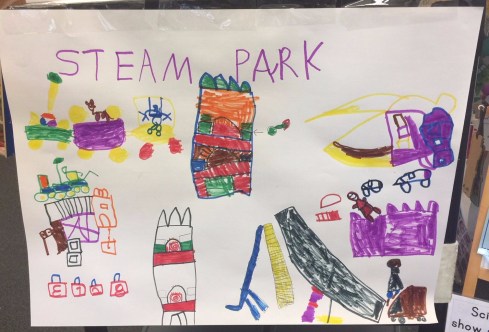
Yesterday on November 1, 2017, LEGO Education launched its STEAM Park kit for preschool-aged students and the early education classroom!

img_08031.jpg

As you know, I have had a relationship with LEGO Education for two years now (let me first state  that I will not receive affiliate compensation for any of the links included in this post). The kit is supported by a lot of research on STEAM education and early childhood education, and includes a curriculum full of activities that teachers and parents can do with their students. This semester, I worked with LEGO Education on the kits and provided them feedback that they could use in developing the activities. All of our work that we’ve been doing with your students for the past few months has been packaged into the following video and case study, and you should definitely check them both out!


Screen Shot 2017-11-04 at 10.54.16 AM

http://bit.ly/2lQAWQ8

The official launch happened at the Children’s Museum of Manhattan in New York City. At the East Boston Early Education Center, I – along with some of my colleagues and students – greeted the new STEAM Park kit with our own “pomp and circumstance” in the form of making.

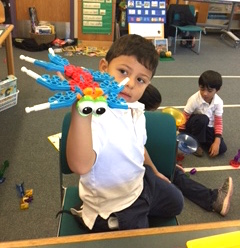
Here are images of our students exploring the new STEAM Park kit together. They’re officially early adopters! I’ve also shared with you several videos that were taken of students and instructors in action during the East Boston EEEC launch. You can watch them at the end of this blog post.

IMG_0795

You can see more of how the launch unfolded on LEGO Education’s Facebook page, and get a glimpse at how my day went on my Twitter feed @ACarrrollYSI. Be sure to tweet #YSI and let me know that you read this blog post. Also, check out the press release for the STEAM Park kit on Business Insider and the review from Geek Mom.


Mealworms and Goldfish and Snails, Oh My!

Animals Two By Two Unit – Kindergarten Young Steam Inventors

Our Young Steam Inventors in kindergarten have been observing two aquatic animals – goldfish and guppies. We’ve read fiction and nonfiction books about fish and used the information to identify the different body parts of the goldfish and guppies and what they need to live. Then, the kindergarten students compared and graphing this information into their STEAM Journals and also documenting their observations. They learned through this process that all animals deserve respect and care.


Our science investigation will lead us into land and water snails in the next few class sessions. We will explore the identifiable structure and behaviors of snails, snail behavior, and needs. We will examine their shells and ask the question, “What will get a snail to move?” The integration of snails and engineering already started last week.  Students were interested in designing a “Snail City” and a Floating City for the water snails. One of the kindergarten  students made the following comment while building snail city:

“Ms. Alicia I’m testing out the roof of my snail bridge. I’m using the fake snail to test to see if I built it strong enough to put a real snail on top. I don’t want the snail to get hurt. The baby snail doesn’t weigh as much as the bigger snails.  I’m also measuring the door with the fake snail so that I know that it is wide enough for the alive snail to get through it. I tested it out once and the fake snail fell so I had to build it aging and make it stronger. Please don’t let anyone break up my bridge.” ~ Delvin, age 5

Kindergarten students are scientists and engineers. They’re making signs for the Floating City for the water snails. I’ve been interviewing the students about their structures on index cars and having them sign their names. They’ve said to me (as I’m writing),

“Ms. Alicia, are you getting everything from my head onto the card just right?”

This is why I love teaching! Right now, we have a floating school, stop signs, bridges, boats, children’s museum and much more! See the photos in this post. The first grade students are choosing to work on the project with kindergarten students.

This slideshow requires JavaScript.

Organisms Unit – Grade 1 Young Steam Inventors

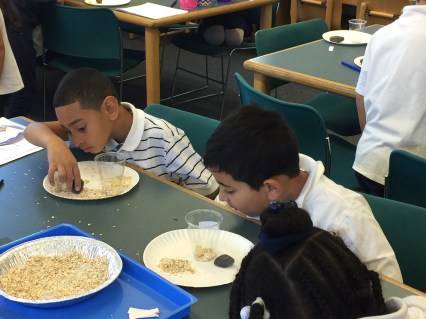
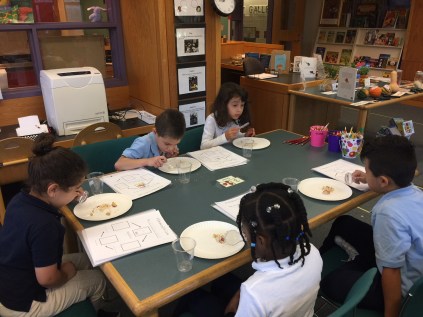
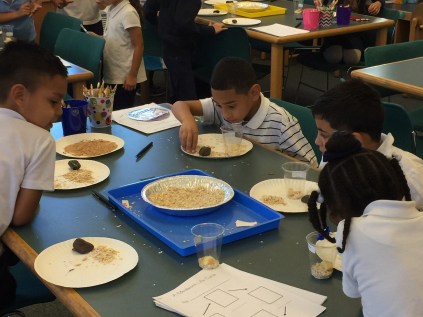
During the last few class sessions, Grade 1 students have been learning about organisms. They learned by exploring the lifecycle of the mealworm that all living organisms need food, air and water to live. While discussing how mealworms begin their life cycle, one first grader said, “They’re just like us. They are tiny eggs and then they turned into a larva, then a pupa and then a baby beetle. We do the same thing except we turn into grown ups”.  Another student remarked, “They go on a life journey, too”.We’ve explored the five senses (sight, speaking, touching, tasting, and hearing) through observations and hands-on experiences. We read fiction and non-fiction books about organisms, went on scavenger hunts outside to find living and non living things, graphed our data and recorded our findings in our STEAM Journals.

IMG_0567

“We are recording the mealworm lifecycle. My mealworm turned into a pupa last night while I was sleeping in my bed”.

IMG_0565

IMG_0568

“We have been observing and writing about this hard word called ‘metamorphosis’. It just means how the mealworms are changing on different days. But how come they wait until we go home to change? That’s my big question!” ~ Mae, Grade 1 student

Our week concluded with a trip to the New England Aquarium, where students got the chance to investigate and go deeper into our learning about living and non living organisms. Please check out the following slideshow!

This slideshow requires JavaScript.


Next week, we will observe and describe seeds. Then, we will plant our seeds and observe how our seeds have changed over time. Grade 1 students have already begun making observations on what happens to an apple, an orange, and a white pumpkin contained in glass jars with no air or water.

In the words of one first grader,

“I want to be a scientist and an engineer when I grow up. I can help Mother Nature with her job because it’s a pretty big job to take care of us and all of the nonliving things in the world”.

Build Me Up, Buttercup

Social emotional learning (SEL) is a set of frameworks that guides practices on how children and adults learn about their emotions and how to effectively manage them for their social, emotional, and academic well-being. This includes being able to show empathy to others, maintaining positive relationships, and being able to talk about one’s own emotions and use them in an uplifting way.

The students and educators at East Boston Early Education Center have been talking a lot about emotions lately. This is because the EEC wants to build a community where emotions are discussed, but also represented. Our school has recently adopted a new t-shirt design with the slogan of “We are safe. We are responsible. We are respectful,” on the back of the shirt, and a grouping of penguins on the front. The penguin was selected by our students as a mascot for the EEC. Now, you might ask, “Why a penguin?” Penguins are very protective of the group and cooperative during the harsh winter months and in the summer. They are loyal to each other, especially to their families, and are respectful. Penguins are also able to adapt to different environments; while they aren’t amphibious, they spend time on land and in the water. These general qualities are what students value in their EEC community. The shirts are also a fundraiser for our school, so if you can, please show your support for the penguins by purchasing one!

EEC Shirt Fundraiser Flyer 2017

SEL Meets STEAM and Making

In the makerspace, I have been exploring social emotional learning with my students through the LEGO Build Me “Emotions” blocks (this is not an affiliate link and I do not get paid for the promotion). Each pack of blocks contains block faces with different emotions – think of them as your phone emojis in LEGO block form – and instructional mats for creating LEGO people with different configurations. LEGO Education also provides with the kits a free curriculum guide with many engaging activities for educators and parents to do with their students, and they also provide training to educators.

We have been using the kits to assist the students with learning about the different emotions and what they look like. Not only can someone be “happy” and “sad,” but they can also be “nervous” and “embarrassed” and “lonely”. A person can also feel multiple emotions at once, as some of the students discovered when building and explaining their emotions. Be sure to check out the slideshow below for photos and captions detailing the emotions that the students were able to “build” in the makerspace.

This slideshow requires JavaScript.


Calling All Interested Parents and Caregivers


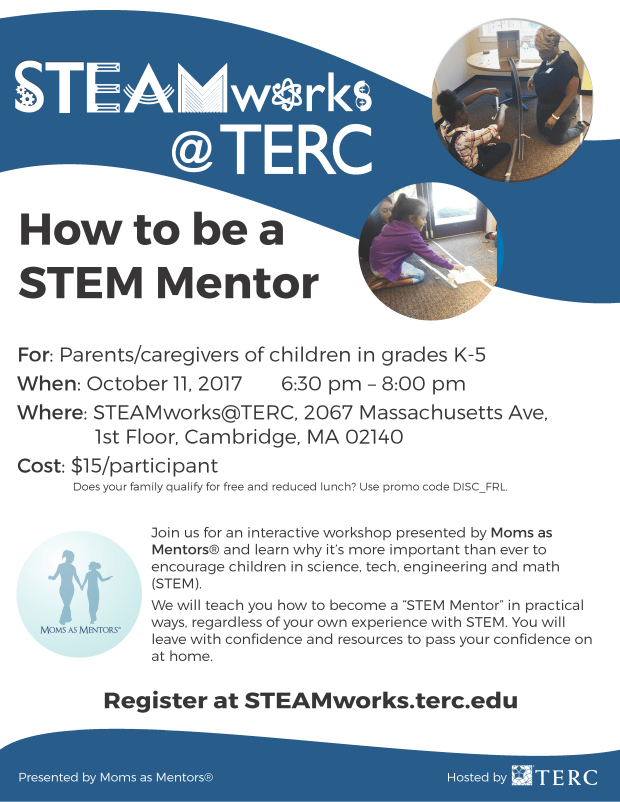
Want to learn how to be an effective mentor for young students in science, technology, engineering, and math (STEM)? TERC is hosting an upcoming workshop on how you can best support the young children in your life in their STEM education.

No experience required, other than a willingness to learn and grow with your child. Click the image below to download and save a copy of the event flyer. You can register for the event at steamworks.terc.edu.

MomsAsMentors_Octflyer_final

A Busy Start To the 2017-2018 School Year

Hello families!

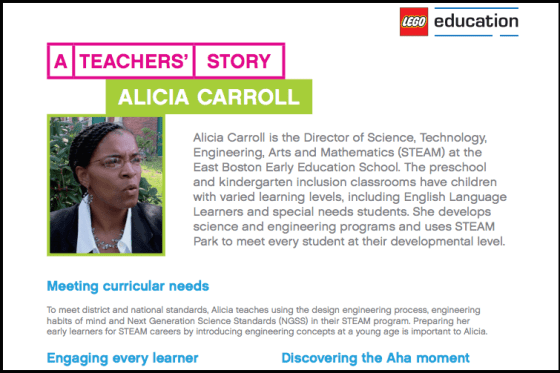
Welcome to a new school year at the East Boston Early Education Center School, as well as to the Young STEAM Inventors blog! My name is Alicia Carroll, and I am the Director of Science, Technology, and Engineering for the East Boston EEC. I have been teaching in Boston Public Schools as an early childhood educator for almost 20 years. I created Young STEAM Inventors to display cultural and student-centered explorations of science, technology, engineering, arts, and mathematics in my urban early childhood classroom. The school year has just started, and Young STEAM Inventors is already busy! We recently exhibited as part of the Boston Public Schools’ BPS Makers booth at the Boston Mini-Maker Faire on September 16.


As I do at every start of the school year, I’d like to provide you with a breakdown of the curriculum that your students will be exploring.

AAEAAQAAAAAAAAWIAAAAJGRhNGU2MDk1LTc4NDktNGRiMy05ZDcyLTM1ZTI5OTI4NWQ0YQ

Before I go into detail about student learning this year, I wish to dedicate this blog post to Alex Brynn Hartley, a young woman who worked with many local STEAM groups – including my previous KinderSTEAM blog and with the Shaw School – as a member of the Boston Teacher Residency Program. It is with a heavy heart that I share the news of her passing, but I am hopeful due to the work she accomplished in spite of her condition and the legacy that she left behind. I send my sincerest condolences to her family.

Grade 1 Science

The first unit will be on simple organisms. Students will develop an understanding of IMG_6890and sensitivity to living things through hands-on experiences. Students create and maintain a woodland habitat containing pine seedlings, moss, pill bugs, and bess beetles or millipedes. They also set up and observe a freshwater habitat, and in a final lesson, students will explore how human beings are similar to and different from other living things.
The second unit students will study is solids and liquids. Students investigate the
similarities and differences of a variety of common solids and liquids by first describing them and then testing them out. They will learn through these investigations how various liquids look and feel, their fluidity, how they mix with water, and their degree of absorption.
IMG_7038

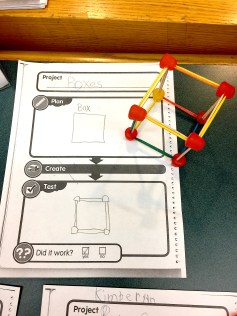
The last unit introduces students to the concept of weather and how it affects their lives. Using a variety of tools, students observe, discuss, measure, and record data on cloud cover, precipitation, wind and temperature. They learn how to read a thermometer and construct a rain gage to measure precipitation. They also study cloud formations, and use a wind scale to estimate the speed of wind. To apply their new skills and knowledge, students compare and record their own weather predictions with actual forecasts and use the weather data they have collected to form generalization about the weather in their location. Students will be recording their experiments and observations in their science journals.

K2 Science

Our first unit is “Animals Two by Two”. Students will observe and describe the IMG_6856structures and behaviors of an organism and then compare the organism to a similar one; guppies and goldfish, land snails and water snails and earth worms and night crawlers. Science concepts are animal behavior, aquarium, habitat, living and non-living things.
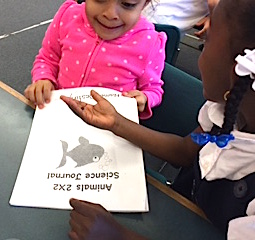
The second unit is “Wood and Paper”. Students observe, compare, and describe natural and synthetic materials such as wood, paper and fabric. They find out what happens when these materials interact with other materials. Students discover applications for the materials in the real world. Students will be recording their learning in their science journals.

K0/K1 Science

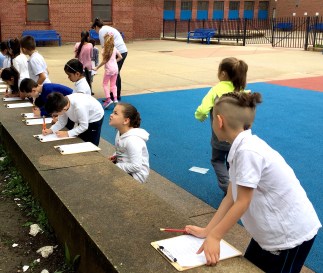
The science for the K0/K1 is integrated into the Opening the World of Learning curriculum (OWL). In the first unit, “Family,” students will explore materials and objects in the environment and observe and identify the characteristics and basic requirements of living things.
IMG_9362

In the second unit, “Friends,” students will observe, explore, and ask questions about materials and objects in the environment and explore the properties and behaviors of many kinds of materials. In the third unit, “Wind and Water,” students will investigate and describe states of matter, explore and discuss what air is and does, record observations by drawing, make predictions, and use simple measurement tools.

In the fourth unit, “The World of Color,” students will describe properties of objects and compare them, observe and describe the effects of sunlight, and explore the properties of plants. In the fifth unit, “Shadows and Reflections,” students will learn about the characteristics and interactions of animals and continue to explore materials. In the sixth unit, “Things that Grow,” students will be exploring the life cycle of a plant and making their own gardens.


#MakersOfColor – Diversity in Maker Education

Josh Ajima's avatarDesign Make Teach

Makers of Color sharing their stories about the importance of diversity in making and maker education. #MakersOfColor

https://youtu.be/5uapwW-cOvw

A curated Makers Of Color playlist is available at https://www.youtube.com/playlist?list=PLNzMzi6xJyxQRIzZIDhWaDonb4Hh2ni6U Suggestions for videos to add to the playlist are welcome.

Share your #MakersOfColor story with @DesignMakeTeach on Twitter. Contact me or leave a comment if you would like to be featured or know #MakersOfColor that need their story told.

View original post